

Content Summary:
- B2B SEO Marketing has changed fundamentally
- Introduction of GEO changed the timelines: Bottom-of-funnel before top-of-funnel
- Top 4 deliverables from B2B SEO Agencies in 2026:
- Target high-intent keywords over high volume ones
- Prioritise Expert-Led Content over generic ones to cater to AI Searches
- Develop true revenue attribution via influenced model vs. “first” or “last” touch
- Utilise 1st-party sales data to develop a SEO content stategy
- When to Challenge Your B2B SEO Marketing Agency:
- They are not proactive enough even or especially when you are unable to deliver information, feedback and decisions on-time
- Expert content is being produced without your input: It’s most likely AI slop
- They have never requested even just a short onboarding process
- Video is not part of their B2B SEO Strategy
The “Vanity Metric” Problem in Traditional B2B SEO Services
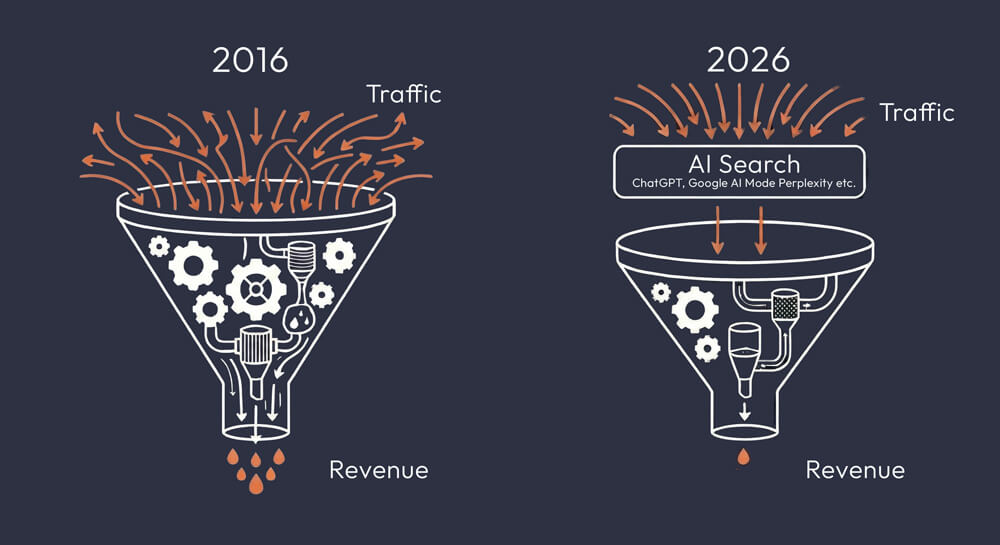
Optimising for volume should not be the main focus anymore.
According to the LinkedIn B2B Institute 95% of buyers are currently not in-market. Or, in other words: Only 5% of your audience is actively looking to buy.
And it makes sense. Businesses are locked into contracts, have plenty of stock or, simply not the budget to be in an active buyer’s stage.
However, this seemingly obvious statistic, has hidden ramifications for how you should deal with your B2B SEO Marketing Agency. Especially in 2026.
Optimising for volume has always been a classic B2C SEO game. And, yet, many B2B SEOs had adopted this principle for their tactics, even when it meant optimising for top-of-funnel keywords.
The reason was simple: Whilst this type of traffic did often not automatically lead to pipeline conversions, it proved a great introduction point for future buyer’s to a B2B brand. And skilled digital marketers managed to capture their information for more nurturing further down the line.
But the game has changed. AI has led to a massive plunge in on-page traffic. LLMs are simply scraping pages and deliver their information directly within their own chat interfaces.
In other words: Many top-of-funnel queries are now not being answered by traditional searches. And targeting high volume keywords has become a bit of a vanity game.
Topical Authority Now Matters Across Platforms
LLMs are not just considering websites for their topical authority mapping. They consider entire brands.
What is means is that it is not important to become an authority over certain topics (important: not keywords) across many platforms – not just your own website.
AI, now embedded directly into Google’s search results, understands, remembers and utilises information on which brand is doing what, when and how across the web and beyond.
This means that for topical authority, brands have to bear in mind more than just their own sites.
Deliverable 1: Commercial Strategy Over Keyword Volume
The “Zero-Volume” Strategy for High-Value Leads
Granted, “Zero Volume” might be misleading. But makes a strong point about a change in overall methodology. For years, volume data on Ahrefs and SEMRush was a north star for SEOs when deciding which type of keywords to focus on.
And it worked. More generic keywords (example: “What is GEO?”) lead to more overall website traffic, which marketers could then in turn use to either re-target or nurture after capturing a visitors email via forms. Or they used cross-channel tracking mechanisms and lead scoring.
However, the game has fundamentally changed with the dawn AI Search.
Timelines flipped upside down: The Dawn of B2B GEO.
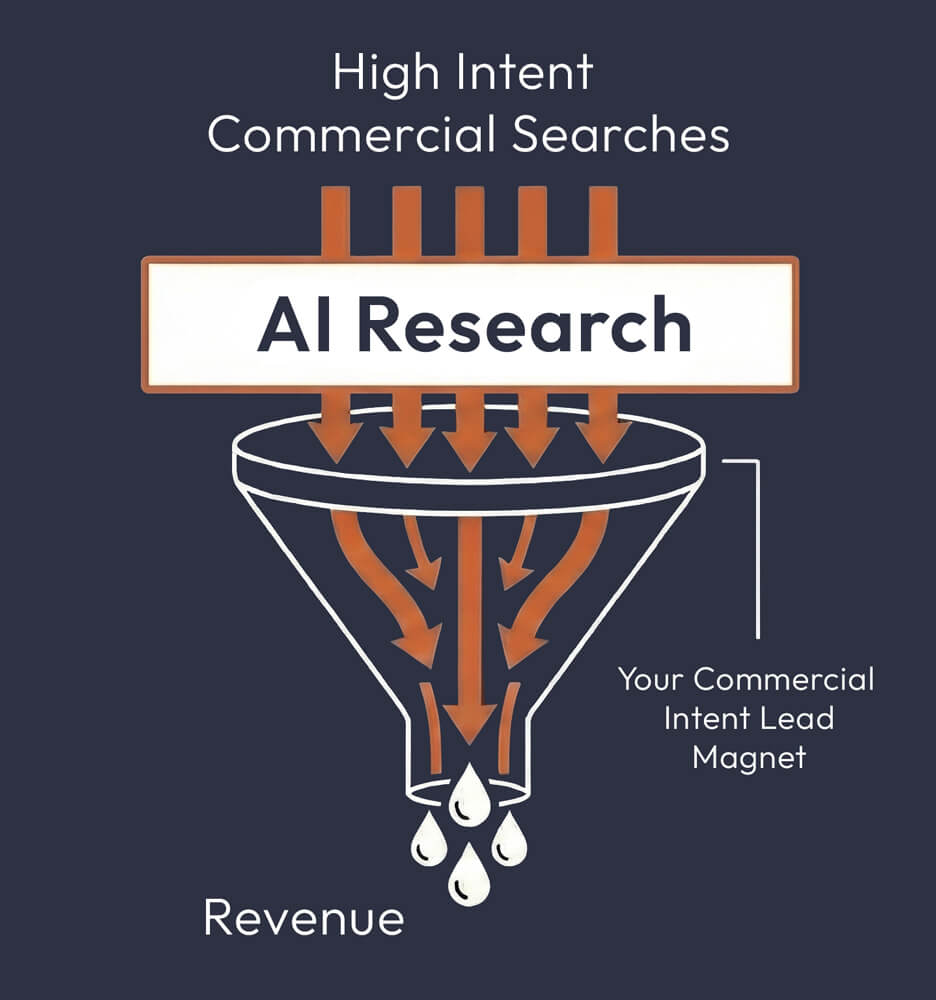
Whilst the classic SEO approach was to start with said high-volume, top-of-funnel keywords, it is almost a reverse methodology for GEO (Generative Engine Optimisation: The work that is needed to be found on generative AI platforms such as ChatGPT, Perplexity and Gemini).
Search marketers have quickly come to the conclusion that optimising your website for high-intent, bottom-of-funnel keywords, for example “Best B2B SEO Marketing Agency in London”, has far greater effect within new search optimisation strategies than was ever the case with SEO.
While the latter has always proven to be a very long-term strategic initiative, given how slowly young websites developed their authority score and, thus, rankings, GEO seems to be less focused on the overall performance history of websites.
And since optimisation for traditional Search AKA SEO and GEO are now going hand-in-hand, with some clear distinctions, the approach to SEO has been changed significantly: The “Zero-Volume”, or should we rather say “Low-Volume-High-Intent” SEO Strategy was born.”
Deliverable 2: Prioritising Expert-Led Content
AI is already too powerful to not be able to serve most answers people are seeking. It takes a vast ocean of information stored online and delivers responses within seconds. Competing with this level of convenience, is quickly becoming pointless.
So, what business have to deliver is information LLMs do not already have. That way they have a higher incentive to utilise your content and assign you topical authority. And what better way to facilitate this than to utilise the knowledge and experience that your internal experts have gathered over many years of problem-solving.
B2B SEO Marketing Agencies should start their assignment by mapping out knowledge clusters within your business and creating a plan how to turn expertise into content. Ideally via video, since it lives upstream of most other content types. But even written articles will suffice.
This is, of course, easier said than done. Said experts are rarely focused on marketing initiatives, but have other responsibilities in the business. However, this is a step-by-step approach and even incremental wins can make a huge different for marketing success.
Deliverable 3: Establish Multi-Touch Tracking For Revenue Attribution
Tracking is probably the most complex category in modern marketing. And maybe the most pretentious. The truth is that especially in B2B Marketing, where sales cycles can be extremely long, definitive attribution against one or two lead source (“Where did this lead come from exactly.”) is an illusion. And SEO and GEO are no exceptions.
Modern B2B SEO Marketing Agencies have to establish a matrix of influences, ensuring leads and, more importantly, created opportunities, are being tracked throughout their entire, lengthy sales journey. “Influenced” and “touched” will not replace “sourced” and “originated”, they already have.
With 20+ touchpoints needed to convert a lead into an opportunity (some say up to 50), there is no such thing as “lead source” anymore. Your B2B SEO agency has to advise you on that and, ideally, assist in building out a multi-touch attribution model within your CRM or Marketing Operations platform. That way you will be able to assess, which page have influenced the most revenue and make informed decisions for the future.
First-party attribution as an important “add-on”
In a privacy-first world, digital tracking can fail. So, yes, it might be time to go back to the good old “How did you hear about us?” field on your demo and contact forms, potentially even for content downloads if they are gated.
Going into the details of tracking fallacies would be too much for this article. However, in short: Any tracking information one can add into the mix is better than no information. It is as simple as that.
You will never get everybody to give you said information, nor will everybody be always 100% truthful. But if it was down to me, I’d rather collect data than leave it on the table.
Deliverable 4: Utilise 1st-party Sales Information For Content Production
Sales as a department will always know more about prospects than marketing. Period. No matter how many tools we adopt or how much budget we spend on “ICP” or “TAM” research.
Utilising information directly from the sales team has always been a winning strategy. Conversations with prospects reveal so much about the market, especially when it comes to pain points, objections and product doubts.
Especially in an AI-first world (yes, it has arrived, deal with it), information from the “horses mouth” is your big differentiator. Everyone can ask ChatGPT or Perplexity what pain points prospects a, b, and c have. But no competitor is (hopefully) sitting on your sales calls and knows what your peers know.
A good B2B SEO Marketing Agency will use that. It will request to sit on your sales meetings and farm information from your CRM, just to get to the high-intent truth only discovery and demo calls can deliver. Objection handling that turns into a high-converting content strategy, so-to-speak.

Warning Signs: When to Challenge Your B2B SEO Marketing Agency
Red Flag #1: When you go slow, they go slower.
Clients often forget “their responsibilities”, mostly when things get busy. So, agency executives have to wait for information, feedback and decisions. Yes, it can stall the process, yes it is ‘annoying’. But it’s the job of an agency to make it work.
The number one red flag for an agency in my opinion is when they are not proactive in those situations, comfortably relying on that one paragraph in their T&Cs that holds clients accountable for delivering XYZ.
And while it may hold up legally, leaning back in such a situation, while still “cashing in” is simply bad practice. Now, don’t get me wrong. There are clients, who are so unresponsive, progress is almost grinding to a halt.
But agencies can tackle even the most difficult of collaborations, by setting up a clear project plan, get senior buy-in and break both their and the client’s deliverables down into short sprints to ensure execution consistency.
Red Flag #2: They take short-cuts with (expert-led) content production
This is a direct follow-up to #1: After failing to engage their client, an agency decide to cut corners and start producing content on their own. While this is not always a bad idea, 2026 will punish anyone, who does not do their due diligence when it comes to content. Especially expert-led content.
Yes, they can write drafts and take inspiration from existing pieces. And they might even succeed in getting it right. But particular content can and should not be produced without an expert in the loop. Even if they are fine with the content and simply approve it as is.
If agencies are miraculously producing high-end content without ever having had the chance to speak to an expert and without being experts themselves, they are most likely using AI to produce the same slop that everybody else posts on their websites. A practice that is either already being punished by LLMs or will soon be for the naughty list.
Red Flag #3: There was never any onboarding process
Nobody wants to afford a lengthy, grueling onboarding process for an agency that might only be around for a couple of months. However, without any formal process to get them up to speed on your business, your products, your customers and your market, they will be unable to do their best work.
Even if the client is not interested in said process, any responsible agency would push for at least a couple of lengthy meetings where they get the context needed to deliver quality output.
Red Flag #4: Video is not part of the equation
Video has always been one of the most potent tools for marketing. With AI Search it has become a significant ranking factor and will become even more important. Since LLMs are creating knowledge graphs and topical authority beyond websites, but in a larger brand context, video has to be a key component.
If a modern B2B SEO Marketing Agency is building a search optimisation plan without considering video as one of the core components, they are most likely not equipped to deliver results that improve either your revenue or your bottom-line.
Speak To Us About Your B2B SEO Marketing Journey
If you would like to learn more about how to onboard and successfully manage a B2B SEO Marketing Agency, book some time with us. We can walk you through our methodology and how we are setting up robust execution sprints, build project plans and utilise AI to get your the most out of your B2B Search Marketing.