

In short
- Email strategy is a sequencing problem. Doing the right things in the wrong order wastes most of them.
- Baseline first, because after the first send there is no clean before to compare against.
- Five segments, and no more. Segment sprawl is what makes a programme impossible to hand over.
- Who receives the email decides the result more than how well it is written.
- Cadence comes from your engagement data. Advice built on consumer newsletters will burn a B2B list.
- Around 70% of marketing-generated leads are never pursued by sales, per the Journal of Marketing, 2013.
Why most email strategies fail on order rather than content
Ask five B2B teams for their email strategy and you will get five lists of tactics. Personalisation. Segmentation. A/B testing. Nurture sequences. Re-engagement.
Every item on those lists is reasonable. The problem is that the lists have no order, and the order is where the value sits. Personalisation applied to a list you have not cleaned wastes the effort. A/B testing on a list that is not segmented tests the wrong variable. A nurture sequence built before anyone agreed the lifecycle stages produces contacts nobody can route.
What follows is the order, and why each step depends on the one before it.
Step one: baseline, before anything sends
The first send changes the thing you are trying to measure. Unsubscribes leave, engagement data appears, and the domain reputation shifts. After that, no clean comparison exists.
So the first week produces numbers rather than campaigns.
- Total contacts, and how many are reachable after bounces and suppressions.
- Engagement by recency cohort, meaning who has opened or clicked in 30, 90, 365 days and never.
- Consent status, and how many contacts have no lawful basis recorded at all.
- Live sequences, how many exist and how many have fired this quarter.
- Domain health: SPF, DKIM, DMARC, and the complaint rate per provider.
The output is one page. It doubles as the argument for funding the work, because the gap between total contacts and reachable contacts is usually larger than anyone in the business expected.
Step two: five segments, and no more
The temptation at this point is to build twenty segments, because the data supports it.
Resist it. A programme with twenty segments can only be run by the person who built it, which makes it fragile, expensive and impossible to hand over. Five is the ceiling.
- Never contacted. Collected and never mailed.
- Once engaged, now dormant. The largest group in most databases.
- Currently engaged. Opened or clicked recently.
- Customers. A different conversation entirely.
- Suppressed. Hard bounces, complainers, no lawful basis, disqualified.
One client-specific cut can sit on top, usually by ideal customer profile. That is the sixth, and it is the last.
Step three: accept that the list matters more than the copy
This is the part teams find hardest, because it reallocates effort away from the fun work.
An excellent email sent to the wrong segment fails. An ordinary email sent to the right segment with the right offer works. If you have limited hours, spend them on who receives the message rather than on the fifth draft of the subject line.
The practical test: before writing anything, state which of the five segments this send is for and what you expect that specific group to do. If the answer covers more than one segment, the send is not ready.
Step four: deliverability before volume
A programme that sends more before it sends correctly damages the asset it is trying to use.
Authentication, warm-up and suppression rules belong before the first campaign. If you are restarting a database that has been quiet, batch size matters more than anything else, because the first send pulls a year of accumulated unsubscribes forward at once.
Step five: cadence from your own data
There is no correct sending frequency, and there is a correct way to find yours.
Start conservatively with the engaged segment. Watch three numbers: unsubscribe rate, complaint rate and reply rate. Increase frequency while those stay flat, and stop when any of them rises.
Ignore cadence advice built on consumer newsletters. A creator mailing a list of millions three times a week is running a different business from a company mailing twenty thousand buyers, and copying that frequency will damage a B2B list quickly.
Why any of this is worth doing
The strongest available evidence for the size of the prize is not a vendor statistic.
Writing in the Journal of Marketing in 2013, Sabnis, Chatterjee, Grewal and Lilien found that around 70% of marketing-generated leads are never pursued by sales. Those contacts were paid for once, through events, campaigns and content, and then left alone.
Email is the cheapest way to reach them again, because the acquisition cost is already spent. What remains is the software and the time of whoever writes the message.
The first ninety days, in one view
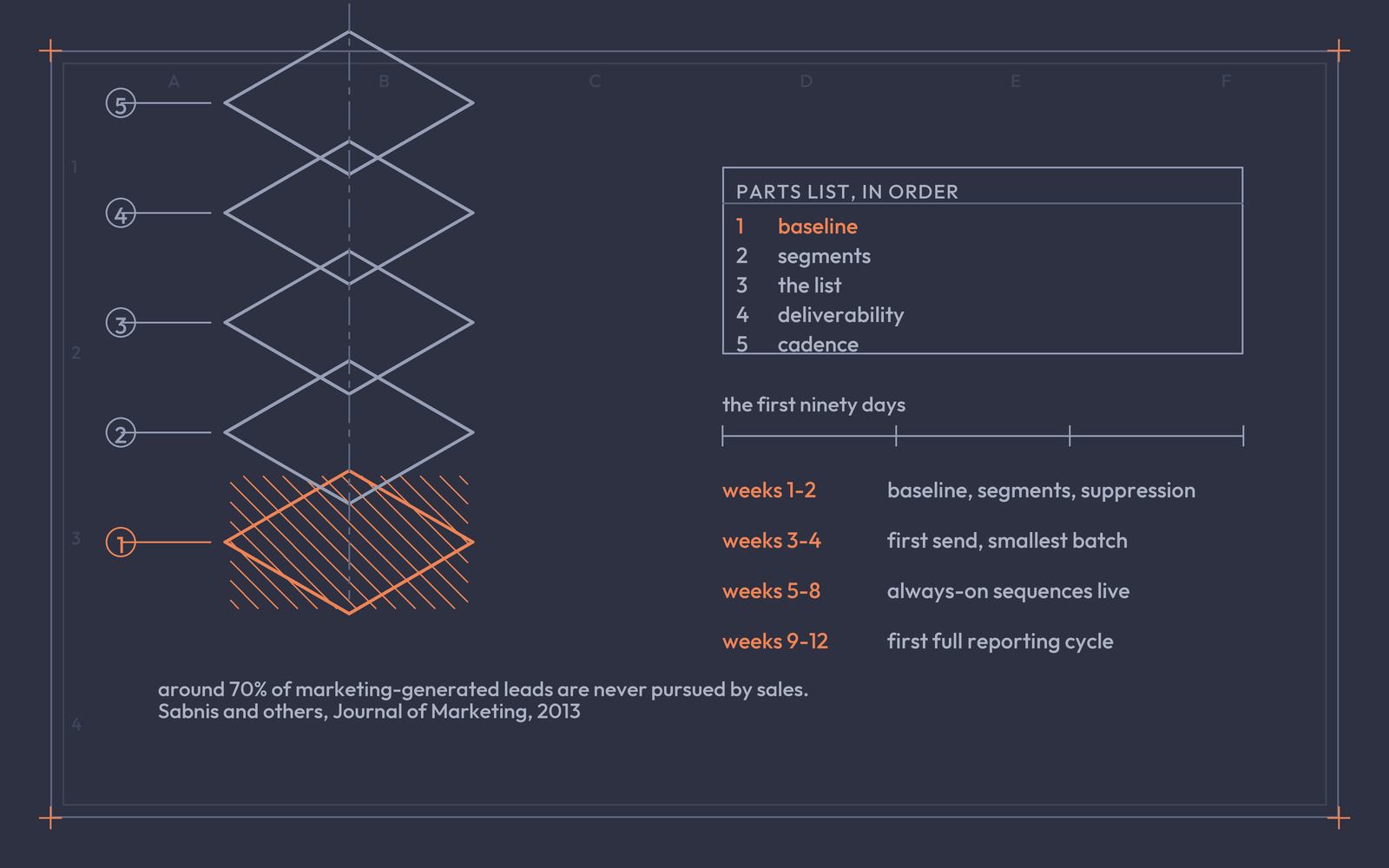
- Weeks 1 to 2: baseline card, segment definitions agreed and built, suppression applied.
- Weeks 3 to 4: first campaign to the dormant segment, smallest viable batch first.
- Weeks 5 to 8: always-on sequences live. New-lead nurture, rolling dormant re-engagement, post-demo follow-up.
- Weeks 9 to 12: first full reporting cycle, and the first re-segmentation using the engagement data the quarter produced.
After that the account produces without weekly build work, which is the point of building it in this order.
Questions, answered
How big does a database need to be for this to be worth it? Around twenty thousand contacts makes a full programme worth a retainer. Below that, the same sequence of steps still applies, and the work is smaller and often better done in-house.
Where does copy fit? After segmentation and before cadence. Good copy multiplies a correct send and cannot rescue a wrong one.
Do we need a new platform? Almost never. The work described here happens inside whatever you already run, and platform migrations usually delay it by a quarter.
What if consent records are missing? Those contacts go to suppression rather than into a sequence. It shrinks the list before it grows, and it is the step that keeps the programme legal.
How do we know it is working? Positive reply rate by segment, meetings booked, and cost per meeting. Open rate no longer answers this question, for reasons covered separately.
Sources
- Sabnis, G., Chatterjee, S., Grewal, R. and Lilien, G. (2013), Journal of Marketing. [VERIFY exact title before publishing]
This is one part of a bigger picture. Start with our guide to B2B email marketing for the whole sequence.