

In short
- The first send to a quiet list pulls a year of unsubscribes forward at once. Plan for the spike.
- Batch size decides whether the restart works. Start with the smallest batch that tells you anything.
- A dormant contact damages your sender reputation more than an unsubscribe does.
- Split the dormant pool by how cold it is, rather than mailing it as one block.
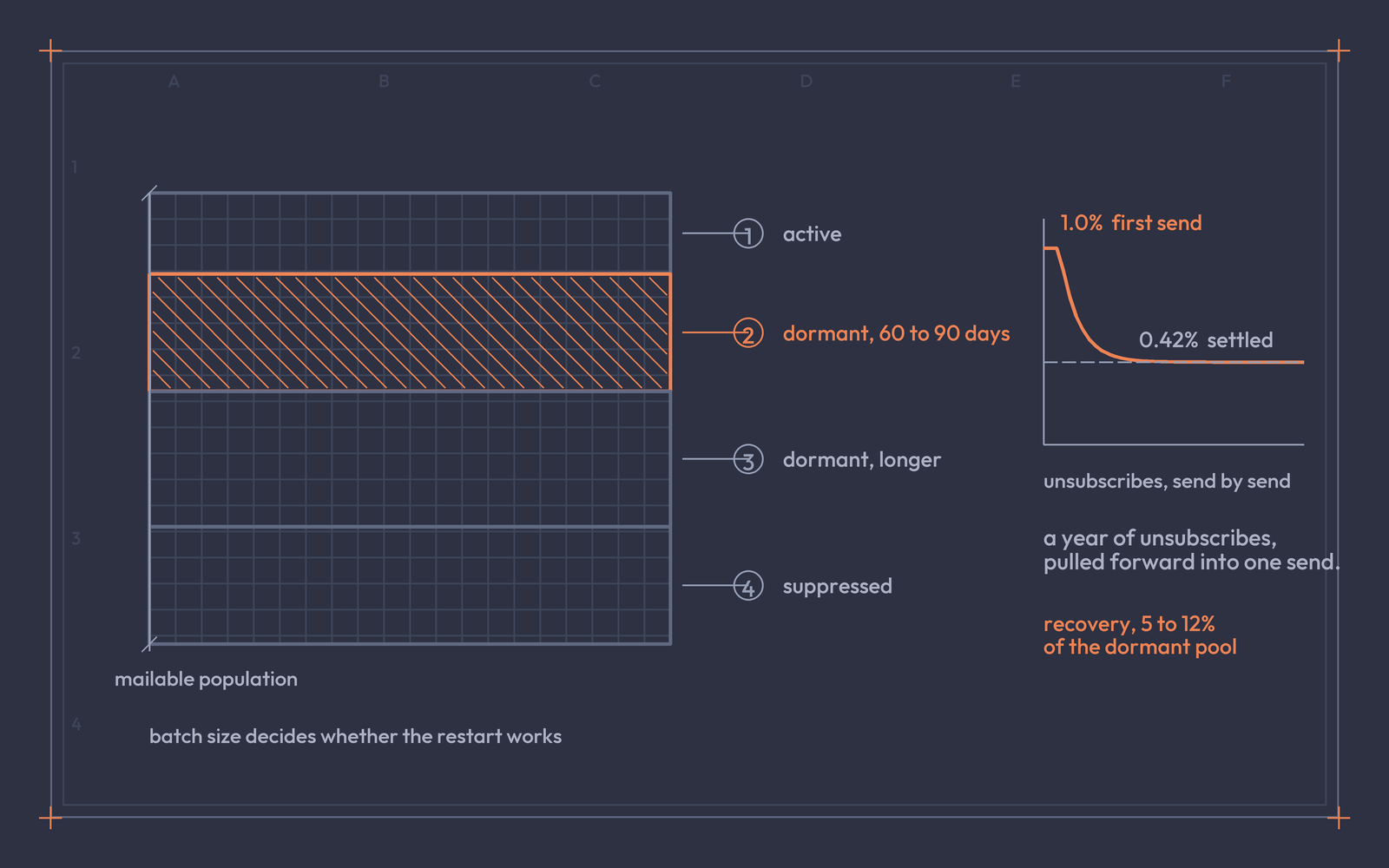
- Practitioner guidance puts B2B dormancy at 60 to 90 days of inactivity, longer for long cycles.
- Finish with a sunset policy, or the same problem rebuilds itself over the next two years.
Why the first send frightens everyone
A company with twenty thousand contacts it has not mailed for a year knows the value is there. It does not send, because the risk feels asymmetric. Mailing might damage the domain. Not mailing costs nothing visible.
That reasoning is wrong in one specific way. Not mailing does cost something, and the cost compounds, because the longer a contact goes uncontacted the less likely they are to respond when you eventually do.
Neslin, Taylor, Grantham and McNeil described this in the Journal of the Academy of Marketing Science in 2013 and called it the recency trap. Purchase likelihood falls as time since last contact rises. Firms observe the low likelihood and contact those people even less, which raises recency further. Nobody decides to kill the database. It dies from being left alone.
What actually happens on the first send
Expect a spike in unsubscribes, and treat it as the process working rather than failing.
A list that has not been mailed for a year has a year of accumulated intent to leave sitting in it. People changed job, changed interest, or forgot who you are. The first send collects all of that at once.
Alex Hormozi describes the same effect on his own list. His first email produced an unsubscribe rate just over 1%, against a settled rate of 0.42% afterwards. That is a consumer list rather than a B2B one, and the shape is the same: one spike, then normal.
The mistake is to read the spike as evidence that the list is dead and stop. The spike is the dead weight leaving, which is the outcome you wanted.
Batch size is the whole game
Everything else in this article is detail. Batch size is the decision that determines whether the restart succeeds.
Send to everyone at once and you learn nothing before the damage is done. Complaints arrive in volume, the provider reacts, and your remaining sends are already compromised.
The sequence that works:
- Start with the warmest slice of the dormant pool. The people who engaged most recently inside the dormant group. They are most likely to respond well, which is what you want the provider to see first.
- Send to a batch small enough that a bad result is survivable. A few hundred, not a few thousand, on a list this cold.
- Wait and read three numbers. Bounce rate, complaint rate, and reply rate. Not open rate, which no longer measures what people think it does.
- Widen only if all three are acceptable. If complaints are near 0.3%, stop and fix the list rather than the copy.
- Repeat, moving progressively colder.
This takes weeks rather than days. It is the difference between recovering a database and burning one.
Split the dormant pool by how cold it is
Treating “dormant” as one group throws away the most useful thing you know about these contacts, which is when they last engaged.
Three bands are usually enough.
- Recently dormant. Engaged in the last few months. Expect the best response, and mail these first.
- Cool. Six to twelve months quiet. A different message, acknowledging the gap.
- Cold. Over a year, or never engaged at all. The hardest group, mailed last, and the one most likely to end up suppressed.
For B2B specifically, practitioner guidance commonly puts the dormancy threshold at 60 to 90 days of inactivity, with longer windows where the sales cycle is long. Consumer benchmarks run much shorter and do not transfer.
Make leaving easy, on purpose
This is the part that feels wrong and is right.
A contact who never opens anything damages you more than one who unsubscribes. The unsubscriber is gone from your metrics. The dormant contact stays in the denominator, drags down your engagement signals, and mailbox providers read that as a sender whose mail nobody wants.
So the unsubscribe link goes somewhere obvious, it works in one click without a login, and it is honoured within two days. That is also now a requirement under the bulk sender rules rather than a courtesy.
What to expect back
Practitioner sources put recovery from a re-engagement programme at roughly 5 to 12% of dormant contacts returning to active. Treat that as a planning range from vendor data rather than a promise, because it varies enormously with how the list was built and how long it sat.
The more reliable expectation is structural. You will finish with a smaller, cleaner, mailable list, a documented consent position, and a domain reputation you can build on. That is worth more than the recovered contacts.
Finish with a sunset policy
If the restart is a one-off, you will be doing it again in two years.
A sunset policy is the rule that stops that. Contacts who show no engagement inside a defined window enter a final re-engagement sequence automatically, and those who still do nothing go to suppression without anyone deciding.
Once that runs on a rolling basis, contacts re-enter and exit as they age, and no future team inherits a database nobody has dared to mail.
Questions, answered
Our list is three years old. Is it worth trying? Usually yes, with a longer ramp and lower expectations on the coldest band. The consent position matters more than the age. If you cannot show a lawful basis, those contacts go to suppression regardless of how promising they look.
Should we clean the list before mailing or let the send clean it? Clean first. Verification and deduplication before the first send, because bounces on a cold list are read harshly and are entirely avoidable.
What if we get a complaint spike mid-restart? Stop sending to that band immediately, and do not continue into a colder band. Complaints are a signal about the list rather than the message.
Do we tell people we have not emailed for a year? Acknowledging the gap tends to read better than pretending it did not happen. It also gives an honest reason for the message.
Who should own this work? Whoever owns the sending domain’s health. In most companies that is nobody, which is why the database reached this state.
Sources
- Neslin, S., Taylor, G., Grantham, K. and McNeil, K. (2013), “Overcoming the recency trap in customer relationship management”, Journal of the Academy of Marketing Science.
- Unsubscribe spike figures: Alex Hormozi, “Learn Email Marketing in 39 Minutes!”, 2024. First-party to his own consumer list, quoted as such.
- Dormancy windows and recovery ranges: practitioner and vendor guidance, 2026. Vendor data.
This is one part of a bigger picture. Start with our guide to B2B email marketing for the whole sequence.